

Table of Contents
Most business owners think branding is something you sort out once and move on from. You hire someone to make a logo, pick your colours, and that’s it, brand done. It is one of the biggest misconceptions about branding for small businesses.
You know that moment when you land on someone’s website and just instantly get it? You know who they are, what they do, and whether they’re for you, all within about ten seconds. That’s a brand doing its job. And you know the opposite too: the website where you scroll and scroll and still cannot quite work out what the person actually does. That’s what happens when the pieces do not fit together.
Your brand is everything that creates that first feeling. And that isn’t just the logo. A brand has more moving parts than most people realise, but it is not as complicated as it sounds once you can see them clearly. There are five of them, and they build on each other. Let’s talk about them.

The elements of your brand
1. You
First of all, you are part of the brand, especially for small businesses and especially coaches.
Not in a way that makes it all about you as a person, but in a way that recognises you’re the driving force behind it. Your values, your perspective, the specific way you approach problems and help your clients, your philosophy about what matters.
This is where it all starts. Not with a mood board or a brand guidelines document. With you. Who are you? What do you believe? What’s your non-negotiable way of working? When you’re clear on these things, everything else becomes easier to work out.
2. Your ideal client
And just like you are part of the brand, so is your ideal client. Knowing who you’re talking to shapes every other decision: the tone you use, the colours you choose, the language in your copy, the platforms where you show up.
If you try to appeal to everyone, you end up appealing to no one. Your message won’t land, and your brand becomes generic. But when you’re clear about who you serve, your brand becomes magnetic to exactly the people you want to attract. Understanding who your ideal client really is is foundational. And yet it is one of the most skipped steps in branding for small businesses.
Check out my article ‘Understanding Your Ideal Client: The Complete Guide’
Does all of this feel a bit overwhelming? Trust me, I’ve been there.
Sometimes it helps to borrow somebody else’s brains!
3. Your name, slogan, logo, fonts and colours
Now we are getting to the part most people think of when they think of branding: the visible stuff. The name, the slogan, the logo, the fonts and colours. This is the layer people see first, which is why it gets so much attention, but it only works when the things underneath it (you, your ideal client, your tone) are already clear.
Take the name. A good business name hints at what you do without being so literal it becomes forgettable. Mine is a good example: my dad came up with Digitalie by combining my name, Natalie, with Digital. Simple, a little personal, and it does exactly what a name should. It hints at the work, it sounds like me, and it has stuck.
The question for you is not whether your name is perfect, it probably does not need to be. The question is whether it still fits. Does it reflect who you are now and who you serve? Or has your business shifted enough that there is a small mismatch starting to show? If you feel it might, take your time. Write down every word, image, and association connected to your work. What mood do you want your name to create? Sleep on it for a few days. The name that still feels right after a week is probably the one.
Your slogan then does the clarifying work your name cannot. It does not need to explain everything, just enough to give people a sense of what you are about. Think of it as a promise, distilled into something short enough to say out loud. It should make someone curious enough to want to know more, not just nod and move on.
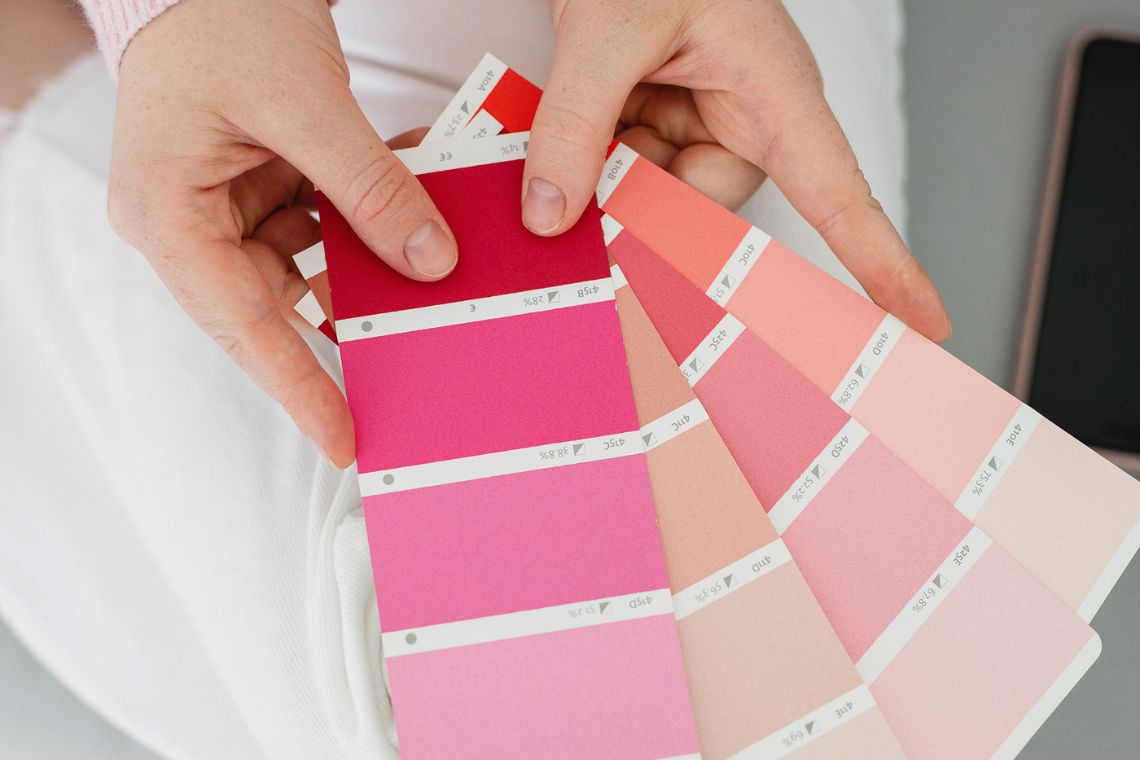
Then comes the visual layer: your logo, your fonts, your colours. These are the things that make your brand instantly recognisable across every touchpoint, your website, your social media, your emails, your documents. A logo that looks beautiful but falls apart at small sizes is not doing its job.
Fonts and colours that feel completely different on your website versus your social graphics create the kind of subtle inconsistency that makes people feel uncertain without knowing why. The visual layer should feel cohesive everywhere it appears, not just on your main sales page.
And yes, that can be quite a search and harder than it looks. But having a good base document with what is important and the vibe you’re going for will help tremendously.
4. Tone of voice

Do you say “clients” or “customers”? Do you write in long flowing sentences or keep things short and punchy? Do you use technical terms or deliberately avoid them? Do you swear occasionally or keep it clean? None of these choices are wrong, but they need to be consistent.
Your tone of voice is what makes people feel like they know you before they have ever spoken to you. When it is the same across your emails, your website, your social content, and your first calls, people feel like they are always talking to the same person. That familiarity is what builds trust.
If you want help working this out, the Marketing Strategy Starter Kit is a good place to start. It walks you through your ideal client, your tone of voice, and more, so you can feel confident about how you are showing up. Grab it below!
5. Your website
Your website is where all of this comes together in one place. Your logo is there. Your tone of voice is in every word. Your colours and design reflect your values. Someone lands on your site and either feels like they have found their person, or they quietly move on.
It might not be the first place someone encounters you anymore, social media has changed that, but it is still where people go when they want the full picture. It is where browsers become buyers. Make it count.
If you are not sure whether your website is doing that job, check out the Website Vibes Check. It’s a great way to see how your website is doing.
By downloading the Website Vibes Check PDF you are subscribing to my email newsletter and agree to my Privacy Policy.
When these ingredients align
When these five elements are pointing in the same direction, something genuinely exciting happens.
Someone discovers you on social media, clicks through to your website, signs up for your emails, and at every step it feels like the same person. The same voice, the same energy, the same values coming through. That coherence is what makes branding for small businesses so powerful; people feel like they already know you before they have ever spoken to you. And that is when trust builds quickly.
The opposite is also true, and worth being aware of. A professional tone on your website but casual on social media. A modern logo but a dated website design. Copy that says you serve coaches but imagery that looks like a corporate office. These small mismatches create a feeling of uncertainty that people cannot always name, but they feel it. And uncertain people do not buy.
The good news is that nothing needs to be perfect. A simple logo that works consistently beats a beautiful one that only shows up properly on your sales page. A basic website that sounds like you beats a polished one that could belong to anyone. Just make sure that what you have isn’t pointing in random directions vibes-wise. That’s what creates brand confusion.

Getting practical
Things change. Your ideal client shifts. Your services evolve. Your values get clearer. That is completely normal, and it does not mean starting over.
The best place to start is to go through each of these five elements and honestly assess where you stand. Not to tear everything down and rebuild, but to spot where things might have drifted or where there is a gap between what you intended and what people are actually experiencing.
Sometimes all it takes is updating your slogan, rewriting a page of your website, or getting more consistent with your visual style. Small tweaks, done intentionally, can make a bigger difference than you might expect.
When you get to the visual layer, you do not necessarily need a designer for everything. Canva is genuinely useful once you know your colours, fonts, and style. Build a template that works and use it every time, rather than making fresh design decisions with every post.
And if you are not sure where to start, begin with your website. It is where everything comes together, and it is usually where the mismatches are most visible. The Website Vibes Check is free and takes about ten minutes. It will give you a quick sense of whether your website is reflecting your brand the way it should.


