

Table of Contents
Here’s something I see all the time: entrepreneurs convinced they need a comprehensive content strategy before they can post anything. They spend weeks (sometimes months) developing elaborate 47-page strategies with frameworks, ideal customer journey mindmaps, and incomprehensible goals. Strategies they’ll never actually use.
Meanwhile, the content they could be creating? It stays stuck in their head.
On the other hand, I also see entrepreneurs posting constantly without any clear direction. They’re showing up every single day on three different platforms, creating content that goes nowhere because there’s no strategy behind it. Just a lot of noise and exhaustion.
Both extremes miss the mark.
After 15 years of helping entrepreneurs with their content, I’ve realised something: the terms ‘content strategy’ and ‘content plan’ are often used interchangeably when, in fact, they are quite different things. And understanding that difference? That’s what helps you figure out which one you actually need right now.
The content strategy vs content plan debate isn’t just semantics – it matters because mixing them up means you might be working on the wrong thing entirely.
A quick word about content strategy vs marketing strategy
Before we dive in, let’s clear up one more bit of confusion: your content strategy and your marketing strategy aren’t exactly the same thing, but for most online entrepreneurs, they overlap significantly.
Your marketing strategy covers the fundamentals of how you’ll grow your business: who you’re targeting, what makes you different, where you’ll show up, and what you want to achieve. For many online entrepreneurs, content is the primary way you market yourself, which means your content strategy and marketing strategy are deeply intertwined.
So when we talk about content strategy below, know that it’s closely connected to your broader marketing approach.
Content Strategy vs Content Plan: What's the Difference?
Let’s start with the basics, because I reckon half the confusion comes from people using these terms to mean the same thing when they absolutely aren’t.
Your content strategy answers: Why and What
A content strategy is the bigger picture. It’s about why you’re creating content in the first place and what you’re going to say. Your strategy includes:
- Your goals – What do you want your content to achieve? (Brand awareness? Leads? Sales? Community building?)
- Your audience – Who are you actually talking to? What do they need to know?
- Your message – What are you known for? What makes you different?
- Your content themes – The big topics you’ll talk about that connect to your expertise
- Your channels – Which platforms make sense for your audience and your strengths
- Your brand personality – How you want to come across (fun? professional? rebellious? cosy?)
Think of your content strategy as your compass. It points you in the right direction and helps you make decisions about what content to create (and what to skip).
Your content plan answers: When and How
A content plan, on the other hand, is all about execution. It’s the when and how of your content. You’ll decide how much you will be posting to each channel (and which specific days) and then create a plan, or a schedule, a content calendar, with what specific content goes where, when and which offer or goal it supports.
Your content plan is like your sat nav. It tells you exactly which turns to take and when, keeping you on track day by day.
Which one do you actually need?

Scenario 1: You have a marketing strategy but struggle with content consistency
→ You need a content plan!
If you’ve already done the foundational work (you know your target audience, your positioning, your goals, your channels), then you probably don’t need a full content strategy. What you need is a content plan.
The content strategy vs content plan confusion often happens here – people think they need to develop an entire strategy when they actually just need a system to execute what they already know.
Here’s the practical bit: if you already have answers to the big marketing questions (who you serve, what problem you solve, what makes you different, where your audience hangs out), then you’ve actually covered many of the content strategy elements already. You’re building on that foundation. Now you just need the system to execute consistently. A content plan gives you the calendar, the workflow, and the structure to actually create and publish content without the constant scramble.
Signs this is you:
- You know what you want to say, you just can’t seem to say it regularly.
- You have clear business goals but your content feels like it’s not leading anywhere.
- You’re always scrambling to post something at the last minute.
- You have great ideas, but no system to turn them into actual content.

Scenario 2: You're posting consistently but not seeing results
→ You need a content strategy!
If you’re showing up regularly but your content isn’t getting people to anything you want them to see, you need a content strategy.
You’ve got the execution part down. You’re creating content, you’re being consistent, you’re putting in the work. But the content itself isn’t strategic. It’s not aligned with clear goals, it’s not speaking to your audience’s actual needs, or it’s not supporting your business objectives.
Signs this is you:
- You post regularly but rarely get meaningful engagement.
- Your content doesn’t seem to attract your ideal clients.
- You’re not sure if your content is actually helping your business.
- You create content because you “should” but don’t know what it’s achieving.
- Your audience doesn’t really understand what you do or how you help.

Scenario 3: You're starting from scratch
→ Get a simple marketing strategy.
If you don’t have a marketing strategy OR a content plan in place, here’s what I’d recommend: start with a basic marketing strategy that includes the key elements of content strategy
Don’t try to create elaborate documents. Just answer these fundamental questions:
- Who am I trying to reach?
- What problem do I solve for them?
- What makes my approach different?
- Where does my audience spend time online?
- What do I want my marketing to achieve?
Once you have these basics sorted, then you can create a simple content plan to execute on it.
Signs this is you:
- You’re brand new to content creation.
- You haven’t really defined your target audience.
- You’re not sure which platforms to focus on.
- You don’t have clear business goals yet.
- Everything feels overwhelming and you don’t know where to start.
The mistake I see people make is jumping straight into content planning without having any strategic foundation. Or spending months on strategy without ever actually creating content. Neither works.
Start with the piece you’re missing, get it working, and build from there.
How content strategy and planning work with marketing circles
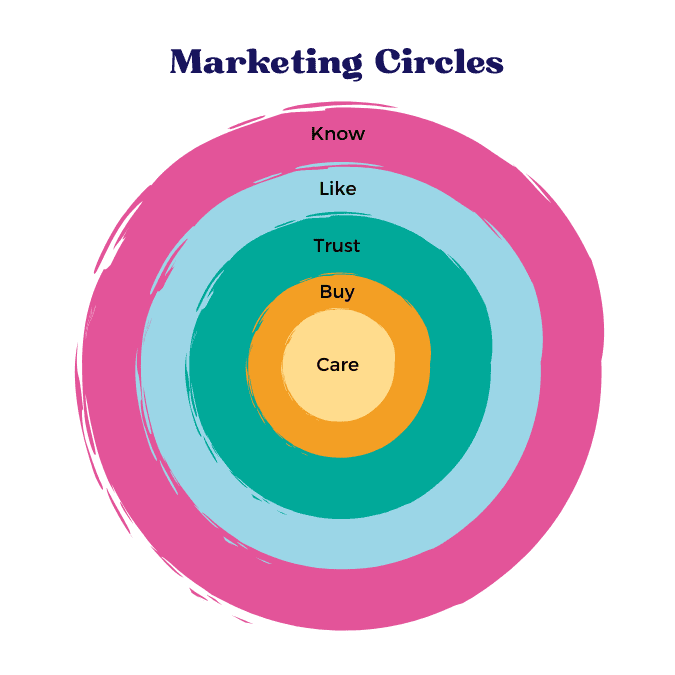
The circles are: Know, Like, Trust, Buy, and Care. People don’t move through them in a straight line. They might circle around ‘Like’ for ages before moving to ‘Trust’. They might jump from ‘Know’ straight to ‘Buy’ if they’re ready. It’s messy, human, and far more accurate than any funnel.
Your content strategy determines which circles you’re focusing on and what type of content and channels work best for each circle. Your content plan then maps out when and where you’ll create that content. But here’s the key: you don’t need content for every circle at once. Start with one or two, get those working, then expand.
Understanding the 6 types of content (Informative, Inspiring, Engaging, Behind the Scenes, Your Story, and Sales) helps you create the right mix for each circle without overthinking it.
Creating a simple content strategy (when you need one)
1. Why are you creating content?
2. Who needs to see your content?
Not “everyone”. Not even “entrepreneurs”. Get specific about who you’re trying to reach. What problems do they have? What are they already searching for?
But don’t overthink this with elaborate persona documents. You don’t need to know their favourite colour or what they had for breakfast. Focus on what actually matters: the problems they’re facing and how you can help.
3. What do you want to be known for?
Pick 3-5 main themes that connect to what you sell. For instance, I talk about content creation, marketing strategy, tech for entrepreneurs, email marketing, and websites. Everything I create falls under those umbrellas.
Once you know your themes, you can start thinking about the types of content you’ll create. There are actually 6 types of content that work together to guide people through their journey with you; from discovering you exist to becoming raving fans.
4. What makes your approach different?
5. Where will potential customers find you?
Not which platforms you’ll use (that’s planning), but where in their journey will they discover you? Through search? Referrals? Social media? This helps you understand what type of content will work.
That’s it. Five questions. You can answer them in an afternoon, on 1 A4 and you’ve got a solid foundation for your content strategy.
Creating a simple content plan (when you need one)
Step 1: Decide your channels and frequency
Don’t try to be everywhere. Pick 1-3 channels where your audience actually spends time and where you enjoy creating content. Then commit to a realistic posting schedule.
For instance: “I’ll publish one blog post per week and share it three times on Instagram throughout the week.” That’s manageable.
Step 2: Set up your content calendar
Use whatever tool actually works for you—Google Sheets, Notion, Airtable, even a paper planner. The tool doesn’t matter. What matters is that you’ll actually use it.
If you want a head start, I’ve created Content Calendar templates for Google Sheets, Excel, Notion, and Airtable that include everything you need to get organised quickly.
At minimum, your calendar needs:
- Publishing date.
- Topic or working title.
- Content type (blog, social post, video, etc.)
- Status (idea, in progress, ready, published)
Want to know more about how I use the offer to create content and learn my full system of creating dynamic marketing?
Step 3: Create your content
Pick a time to create your content. You can create one piece at a time as needed, but I highly recommend batch creating when possible; setting aside time to create multiple pieces simultaneously. Write three blog posts in one sitting. Create a month’s worth of social graphics in Canva. Record several videos back-to-back.
Batching is how you make creating content easier for yourself. If you want to learn more about how to make bulk creation work for you, check out my guide on how to create a lot of content quickly.
Step 4: Save what you've created
As you create content, save it in an organised way so you can easily find and repurpose it later. Blog posts you can link to. Social media graphics you can reuse. Videos you can turn into multiple posts. This becomes your content library.
Your content calendar can serve as your library, storing both upcoming content and everything you’ve already published. The more you build this, the easier future content gets because you’re not starting from scratch every time.
Measurement: The helpful next step
Here’s something that can really help once you have your strategy or plan in place: measuring what’s actually working.
I see this all the time: entrepreneurs create a brilliant strategy or meticulously plan their content, then just… post and hope. They never actually check if their assumptions were right. They don’t know which content brings in clients, which topics resonate, or what’s just taking up time without results.
Measurement helps you find out if your strategy is sound and if your plan is effective. It’s how you discover that your audience actually prefers videos over blog posts, or that your Thursday emails get twice the opens of your Monday ones, or that the content you thought was brilliant is falling completely flat.
Is it essential? No. But it’s incredibly helpful when you want to grow or improve what you’re doing.
The key is keeping measurement simple. Pick 2-3 metrics that actually matter for your goals:
- If your goal is visibility: track website traffic, social media reach, or new followers
- If your goal is engagement: track comments, shares, email replies, or time on page
- If your goal is leads: track email signups, discovery call bookings, or content downloads
- If your goal is sales: track actual revenue from content-driven customers
Check these metrics monthly (not daily, that’s just anxiety-inducing) and ask yourself: Is this working? What’s surprising me? What should I do more of? What should I stop?
I’ve written a complete guide on how to measure your content performance effectively without getting overwhelmed by data, because this is where a lot of entrepreneurs get stuck.
When you might need professional help
Look, I help people with content strategy and planning all the time. It’s literally what I do. But I’m also honest about when you actually need help and when you’re better off just getting started.
You might want professional support if:
- You’ve tried on your own and it’s not working – Sometimes you need someone to help you see what’s actually holding you back. Book a Pick My Brain session and we’ll sort it out in 30-60 minutes.
- You’re overwhelmed by all the options – When everything feels like too much and you need someone to help you focus on what actually matters, a Pick My Brain session can cut through the noise.
- You want to make sure your content connects to your business model – The Content Success course teaches you the system for creating content that actually supports what you sell.
- You need accountability to actually implement – Having the plan is one thing, following through is another. Marketing Momentum gives you the accountability and support to keep moving forward.
- Your content needs to scale but you don’t know how – Let’s figure out what’s working and how to do more of it. Pick My Brain can help you identify your next steps.
The bottom line
The content strategy vs content plan distinction matters because you probably don’t need both right now. You need whichever one is currently holding you back.
If you’re inconsistent, you need a plan.
If you’re consistent but not seeing results, you need strategy.
And whichever you choose? Keep it simple. The best strategy or plan is the one you’ll actually use, not the one that looks impressive in a Google Doc nobody ever opens.
Start with one, get it working, and build from there. Your content doesn’t need to be perfect. It just needs to exist and serve the people you’re trying to help.


