
Table of Contents
A client was walking me through her own opt-in flow on a call recently. “Once they join they get an automation, then they get a nurture sequence, and then the tag is removed. And then they get put into a different nurture sequence. No? They get tagged? I don’t know. I don’t know what that step is. I didn’t set this up.”
She wasn’t able to tell me what happens the moment someone signs up, which is not a “her” problem. I’ve seen it with plenty of clients.
If you are also confused about what’s happening inside your email marketing, you’re in the right place.
Almost nobody can explain their own setup
When I ask people to walk me through their own sign-up flow live on a call, most cannot do it. Not because they’re careless.
There are several reasons, and they’re all real:
- Nobody ever taught them how the pieces fit together.
- The account has grown too big to hold in one head.
- It’s years of building catching up: a tag here, a sequence there, until nobody has stood back to look at the whole thing.
- Somebody else built it. A consultant set it up, the working relationship ended, and now it’s yours to run without ever really knowing how.
I’ll put myself in that second one. I don’t think I could fully explain some of my own automations without opening them back up and taking a proper look. Scale catches everyone eventually, me included!
One client of mine put it this way, early in our first call: “I have an overview, but barely. I’m close to knowing, oh, that’s what this does, but it’s getting so big that I don’t.” It might be the same for you. You know enough to know that things aren’t going quite right, but not enough to know how to fix it. It’s the hardest place to be, because you can’t get a proper grip on it from where you’re standing. Most people are in exactly that spot when they finally sit down and look at it properly.
A list of what you have is not a map of what happens
You might already have an inventory somewhere. A spreadsheet of every sequence, every tag, every automation you can find. If you’ve never reviewed your email marketing at all, that’s the place to start, and it’s worth doing properly.
But an inventory tells you what you own. It doesn’t tell you what happens to a person. You can have every automation logged in a tidy list and still not know that someone who signs up for two different freebies gets dropped into two welcome sequences at once, both firing, neither one aware the other exists.

A map is different. A map follows one person, in order, from the moment they land on your sign-up form to wherever your system currently leaves them. It’s the piece an inventory can’t give you.
And it’s the piece almost nobody actually draws. Not because they’re avoiding it. Most people skip it because it never occurred to them that mapping was something they were allowed to do. It’s not a standard step anyone tells you about. Where there is real resistance, it’s usually that mapping feels like it’s taking time away from something that looks more like progress: sending the next email, building the next automation, doing something you can point to.
But the thinking is doing something! A lot of people assume the doing is what costs money and the thinking is free, when the thinking is often the most valuable part of the whole job. Skipping it doesn’t save you time. It just moves the cost to later, when you’re troubleshooting something you can’t see the shape of.
Start with what is actually happening
Usually you draw the current version first. Not what you meant to build, not what you’d do if you started again today. Jump straight to designing the system you want and you skip past the exact spot where the mistakes are hiding, building your new plan on assumptions about the old one that turn out to be wrong.
How much the current map matters depends on two things, and one of them runs the opposite way to what people expect.
The first is size. The bigger and messier the account, the more you need the current map, and the more you’ll be tempted to skip it because drawing it feels like a slog. That temptation is the tell. If it’s too big to hold in your head, it’s too big to fix without seeing it laid out.
The second is how much of the mess is worth keeping. If most of what you have still earns its place, map it, so you know what to protect. If almost all of it needs to go, you don’t need a detailed map of something you’re about to bin. You do still need one honest look, enough to be sure it really does all need to go and you’re not about to delete the one automation that was quietly working. Then you can draw the new one straight away.
Either way, draw it ugly! Boxes and arrows on paper, sticky notes, whatever you’ve got. Nobody else needs to see this version, and it doesn’t need to be correct on the first pass. It just needs to be honest. “It’s complex enough that I don’t know what I’m looking at” is how one client described her own back end to me, the first time she properly opened it up. If that’s you too, start from there. Confusion isn’t a reason to wait until you feel more on top of it. It’s the reason to start.

But you can only go so far drawing it from the inside. You’ve sketched what you think happens, working from triggers and tags and what each piece is meant to do. Your subscriber experiences none of that. So check your map against reality: sign up to your own list, the same way a stranger would. Fill in the form, hit submit, and wait.
- Is the first email the one you think fires first?
- How long is the gap before the next one?
- Does anything arrive twice?
- Does anything arrive that has nothing to do with what you just signed up for?
And what if you sign up for 2 things at the same time, then what happens? If things go wrong, they might be getting two welcome emails at once, maybe completely the same, or with only 1 sentence different. Or, worse, they might say contradictory things. You built this system from the inside, thinking about triggers and tags and what each piece is meant to do. And it works, your account shows two clean, separate flows. However, your subscriber experiences none of that. They get a mess. This overlap is one of the things the map is going to show you.
Love the idea of and organised email flow, hate the idea of doing it yourself? 😉
Let me lend you a hand!
What people find when they finally look
Once you’ve drawn the current map and walked through your own sign-up as a stranger, a pattern usually shows up fast. Here are the ones I see again and again:
- People not getting a welcome flow they should be getting.
- People getting a welcome email series they shouldn’t be getting, because an old automation never got switched off when a new one replaced it.
- Do not disturb tags that get added and then never taken off, quietly excluding someone from everything for good, long after the reason for adding the tag has passed.
- And moments where you could easily offer someone the next thing, a related freebie, an upsell, a next step, and right now nobody is.
None of this is anyone being careless. It’s what happens when a system gets built in pieces, over years, by someone solving one problem at a time rather than looking at the whole thing at once. Which is, of course, exactly how everyone builds theirs. Including me. It’s also worth cleaning up who’s still on your list while you’re in here, since a do not disturb tag and a subscriber who’s quietly gone cold often turn out to be sitting in the same corner of your account.
Then draw the one you want
Once you can see the current picture clearly, draw the one you actually want right now. Not tomorrow’s version, not the one you’ll build “eventually”, when you hit 50,000 subscribers, when you finally launch the course, when whatever you’re waiting for arrives. We are creating one you want for your business right now if you were starting fresh. And in a way, you are. Not because you’re throwing everything out, but because for a moment you get to forget what’s already built and ask the simpler question: what do I actually want to happen here? You answer that on a blank page first, then fit what you already have around it.
This isn’t just the current map with the mistakes rubbed out. It’s where you add the moments that were never there: the welcome flow nobody’s getting, the next thing you could offer and don’t. Fixing what’s broken is half of it. The other half is building in what was missing.
The gap between your current map and your wanted map is your to do list. Not a vague sense that things need fixing, an actual list, because you can now see exactly where the two pictures don’t match. Freebie overlaps are usually near the top of that list. Once you can see where they collide, set the automations up so they account for each other.

On your own, or with someone in the room
You can do a genuine amount of this alone. With a proper workbook and an hour where nobody interrupts you, most people can draw both maps, spot the overlaps, and come away with a clear list of what to fix. Sometimes that’s the whole job, and I mean that.
I built the Email Flow Map for exactly this: a €9 workbook that walks you through the process, current state first and then wanted state, the same four questions at each stage, so you’re not starting from a blank page. You can get it here.
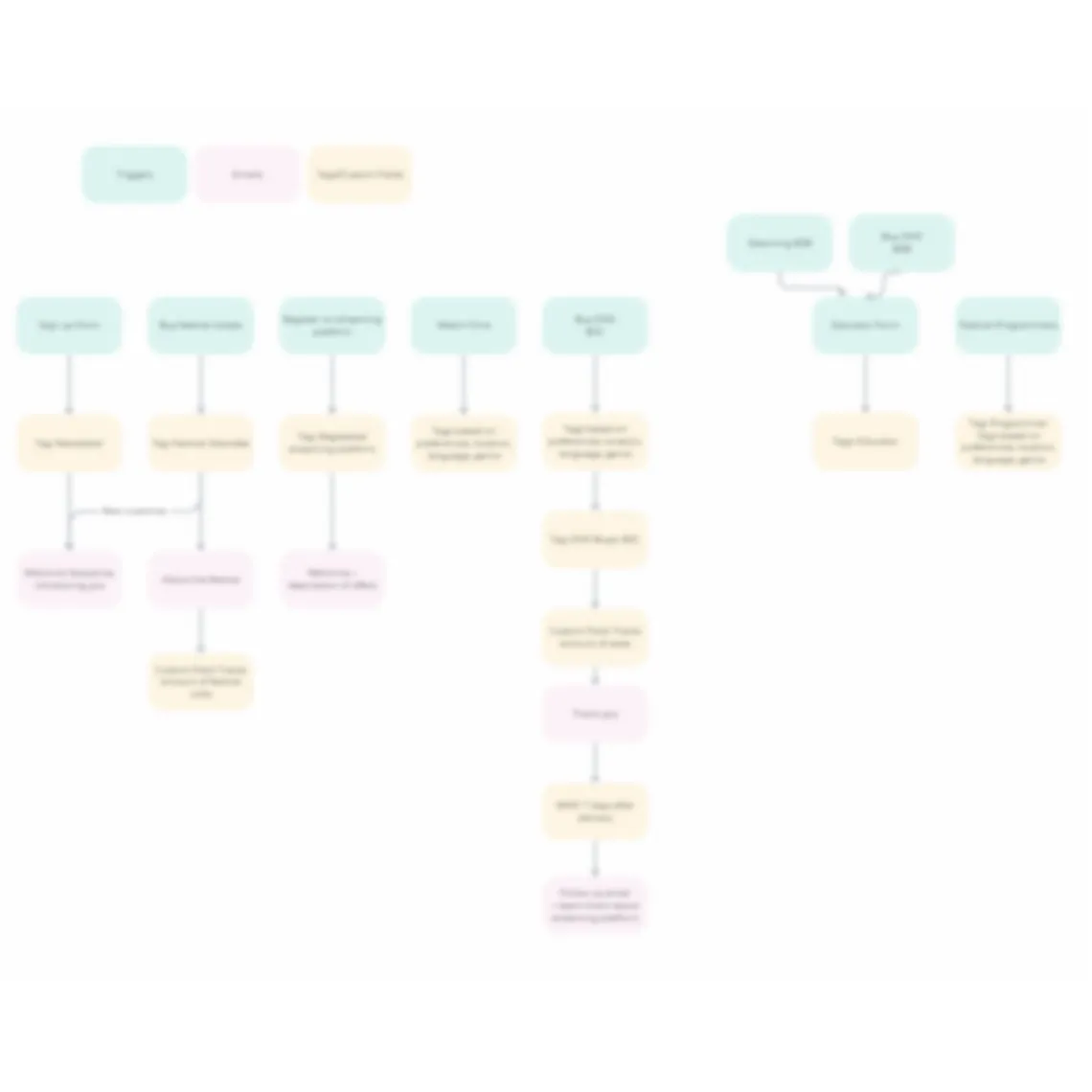
Other times, you draw your own map and get stuck at the moment that matters most: “wait, is this actually right?” Or “is there something here I could improve?” Or, quite often, “why does this feel so complicated?” That’s usually the sign that having someone else in the room is worth more than another hour alone with it. One client told me afterwards: “I was too close to my business to see what needed to happen and knew I needed help.” Another said: “I really liked that you could watch my screen. That made it a lot more personal and certainly clearer.”
If that’s the stage you’re at, the 2-hour Visual Strategy Session in Pick My Brain has an Email Marketing Flow format built for exactly this: we map it out together, on a screen, in one sitting. You’ll find it here.
Visualise your email marketing flow
You don’t need the perfect system to start. You need an honest picture of the one you already have, and permission to draw it badly the first time.
So sign up to your own list this week and watch what happens. What’s the first thing you think you’ll spot?